
US and Philippines Launch Pax Silica AI Manufacturing Hub

The US and the Philippines are developing a 4,000-acre manufacturing hub designed to address critical vulnerabilities in global supply chains, particularly around semiconductor production and rare earth mineral processing.
The initiative comes as supply chain security has emerged as a strategic priority for Western nations seeking to reduce dependencies on Chinese suppliers.
According to the US State Department, the hub will secure inputs vital to US and global supply chains, with a particular focus on semiconductor supply chains.
The announcement comes amid heightened tensions between the US and China over rare earth minerals.
The timing reflects growing recognition among supply chain leaders that current dependencies represent an unacceptable risk.
China currently accounts for roughly 70% of rare earth mining, 90% of separation and processing and 93% of magnet manufacturing, the Centre for Strategic and International Studies reports.
Addressing supply chain concentration risks
The manufacturing zone represents a fundamental shift in how allied nations approach supply chain resilience.
Designated by the Philippines as an Economic Security Zone, the site is the first of its kind and forms part of the Pax Silica Initiative, the Department of State's effort on AI and supply chain security.
Undersecretary of State for Economic Affairs Jacob Helberg tells the Wall Street Journal: "The current geography of the global supply chain is completely unsustainable.
"If you look at the whole supply chain stack, layer after layer, it is totally dominated by China."
The hub is expected to serve as a purpose-built platform for allied manufacturing, functioning as an "investment acceleration hub" where specific industrial activities will be shaped by market demand, host-country comparative advantages and the evolving needs of the allied network.
The State Department said the administration will ask companies to put forward proposals to compete for a spot in building out the hub, giving priority to bids that move critical minerals processing and manufacturing away from Chinese suppliers.
Strategic positioning within regional corridors
Situated within the Luzon Economic Corridor, the zone could leverage the Philippines' geographic centrality in the Indo-Pacific region.
The State Department highlighted the country's young and technically skilled workforce as an additional advantage for supply chain operations requiring advanced technical capabilities.
The Philippines holds significant reserves of nickel, copper, chromite and cobalt.
These elements are used in a variety of manufacturing industries, including energy storage, batteries, wind turbines and the metallurgical industry.
Helberg tells the Wall Street Journal that the resources will be used by US companies operating in the new hub in the Philippines and exported back to the US for manufacturing.

Building resilient networks through partnerships
The new announcement builds on strengthening bilateral relations focused on supply chain integration.
Senior officials of the Philippines and the US have met in Manila for the Philippines United States Bilateral Strategic Dialogue, where they agreed to catalyse private sector development with a focus on the areas of transport, logistics, energy and semiconductors.
The Pax Silica Initiative, under which this hub is being developed, spans advanced manufacturing and AI infrastructure with a goal to "reduce coercive dependencies".
For supply chain professionals, this could signal a broader shift towards distributed manufacturing networks that reduce single-point vulnerabilities whilst maintaining efficiency and cost competitiveness.
The conceptual site represents an attempt to redesign supply chain architecture for critical inputs, moving from concentrated sourcing models to diversified networks that could offer greater resilience against geopolitical disruption.
As companies evaluate their exposure to supply chain concentration risks, such government-backed initiatives could provide new options for securing access to essential materials.
Company portals
Executives
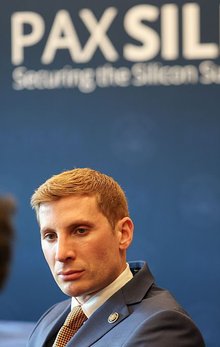
Jacob Helberg
US Under-Secretary of State for Economic Affairs